
Technology evaluation
Drone as First Responder: From Technology to Evidence
As DFR continues to grow, empirical evidence will be essential for understanding where and how it delivers value.

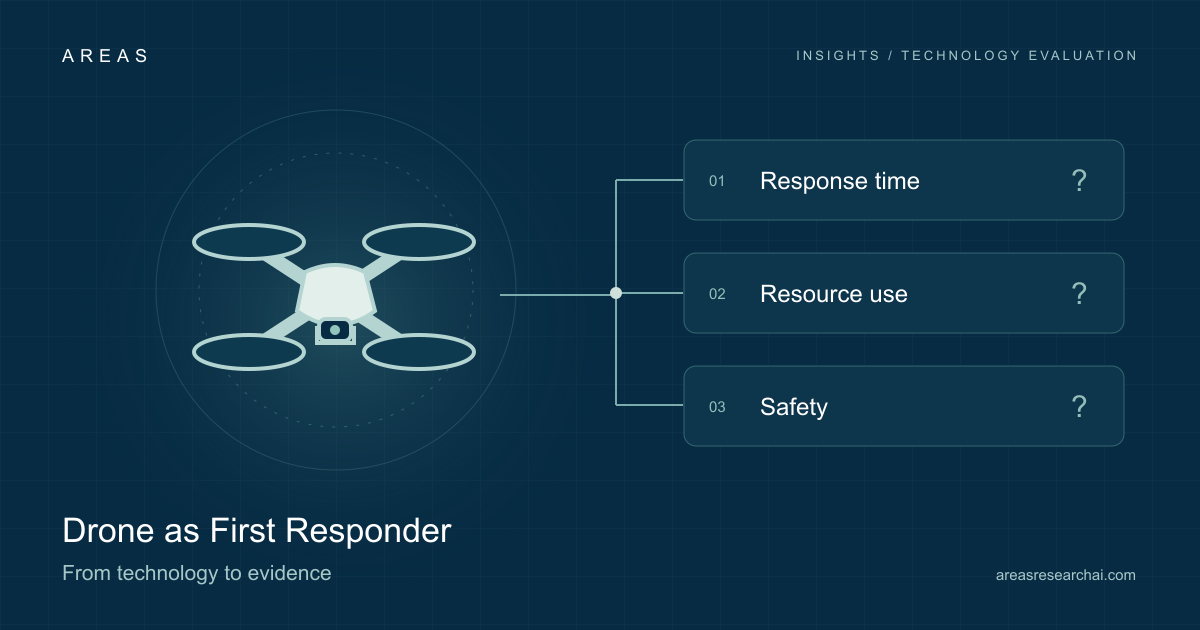
Drones are becoming a common tool in public safety. Law enforcement agencies are using them to get real-time information, improve situational awareness, and support decision-making during emergencies.
One of the newer approaches is Drone as First Responder (DFR). Unlike traditional drone use, DFR allows a drone to be sent to an emergency call before officers arrive. A trained operator can monitor the live video and provide information to responding officers.
The idea is simple. Getting information to officers earlier may help them better understand what is happening before they reach the scene. It may also help agencies use their resources more efficiently and improve safety during uncertain or high-risk situations.
The model was first introduced by the Chula Vista Police Department in 2018. Today, about 1,700 U.S. law enforcement agencies use drones in some capacity. However, only a smaller number have adopted DFR programs. As more agencies consider this approach, an important question remains: Does DFR actually improve police response to crime?
There is still limited empirical evidence on whether DFR leads to measurable changes in policing and crime-fighting. This is where research becomes important. Rather than focusing only on what the technology can do, we need to understand what it actually changes in practice.
This is the type of question that drives the work at AREAS. By combining data, research, and analytical methods, AREAS helps examine whether new technologies and programs are producing measurable outcomes.
For DFR, the focus is not just on sending a drone first. It is on understanding whether doing so leads to faster responses, better resource use, and meaningful improvements in police operations. As DFR continues to grow, empirical evidence will be essential for understanding where and how it delivers value.
Continue the conversation
What does your technology change in practice?
Work with us to define the question, examine the evidence, and evaluate the outcomes that matter to your organization.
Discuss an evaluation