
Applied AI
From AI Pilot to Everyday Use: What Makes the Difference?
A focused task, representative data, measurable quality, and clear human review help organizations decide when an AI pilot is ready for everyday work.

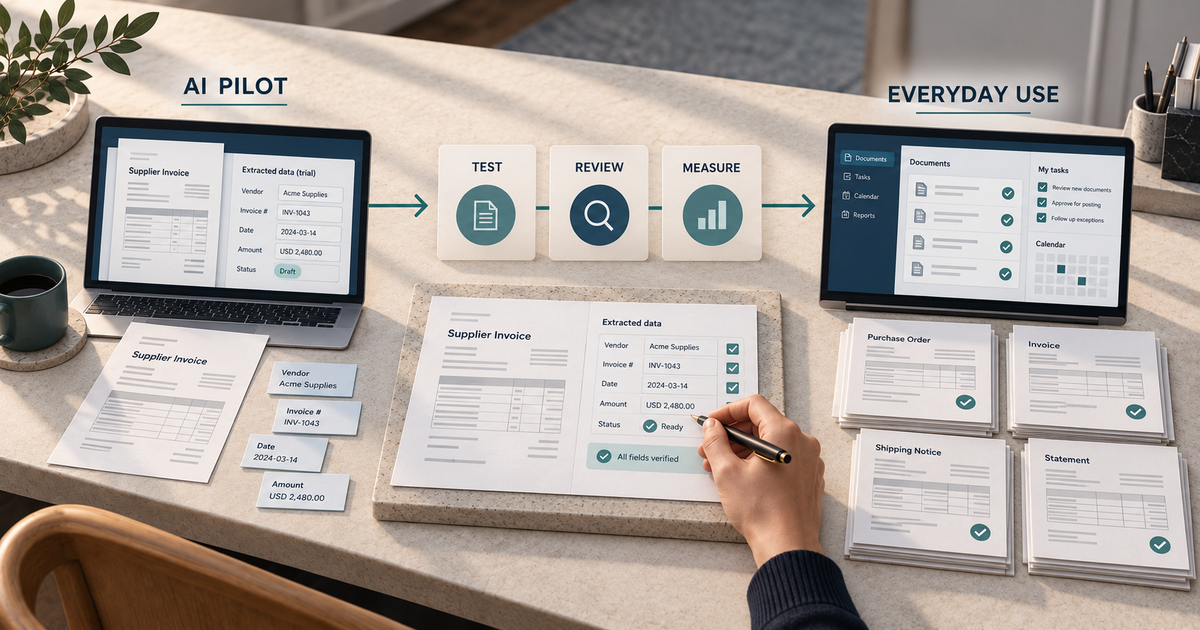
An AI pilot becomes valuable when people can depend on it in their everyday work.
The opportunities are practical. AI can help teams find information across documents, turn reports into structured data, prepare routine summaries, and forecast workload. These capabilities can make previously time-consuming work more manageable and create new ways to use information an organization already holds.
Moving from a promising pilot to everyday use requires several decisions about how the tool should work, how its performance will be assessed, and what happens when it makes a mistake.
From my experience building production AI and machine learning systems, those decisions deserve attention from the beginning.
Start with a clearly defined task.
“Use AI to improve operations” is difficult to test. “Extract five agreed fields from incoming reports and flag uncertain results for review” gives a team something concrete to build and evaluate. A focused task makes it easier to identify the required data, the intended users, and the boundaries of the tool’s responsibility.
Test with the information people actually use.
Everyday records contain missing fields, inconsistent terminology, outdated documents, and unusual cases. A useful pilot should include these conditions. Testing with representative material helps reveal where the system performs well, where it struggles, and how much preparation the data requires.
Agree on what success means.
Accuracy matters, but so do processing time, operating cost, and the effort needed to check the results. A tool that generates an answer quickly may still require substantial correction. Compare the complete workflow with the existing process, including human review. Recent engineering guidance on evaluating AI agents reinforces the importance of checking actual outcomes and testing the model together with the surrounding system.
Make human review specific.
Decide which outputs require approval, who is responsible, and what information they need to check the result. For a document assistant, this might mean showing the supporting passage and document version. For an extraction tool, it might mean routing incomplete or inconsistent records to a reviewer. Review should be an achievable part of the workflow.
Plan for continued use.
Someone needs to own the tool, monitor errors and costs, and decide when changes require further testing. Documents change, user needs evolve, and model updates can affect behavior. Wider use also requires an explicit plan for integration, hosting, and support.
A well-designed pilot gives an organization evidence for its next decision. That may be to expand the tool, improve a specific weakness, or reconsider the approach.
At AREAS, we bring research, evaluation, and applied AI engineering together to help organizations make these decisions. We start with a defined use case and test accuracy, time, cost, and failure cases against agreed requirements.
If your organization is considering an AI application, we welcome a conversation about the task you want to improve and the evidence you need before relying on it.
Continue the conversation
Which task could an AI pilot help you improve?
Work with our team to define the records, review process, and evidence you need before expanding an AI workflow.
Discuss a report workflow